Quantum Computing Becomes Real in 2025: Why the U.S. Is Entering a New Era of Computing Power
For more than a decade, quantum computing lived mostly in the world of theory, laboratory prototypes, and ambitious projections. But Quantum Computing Becomes Real in…

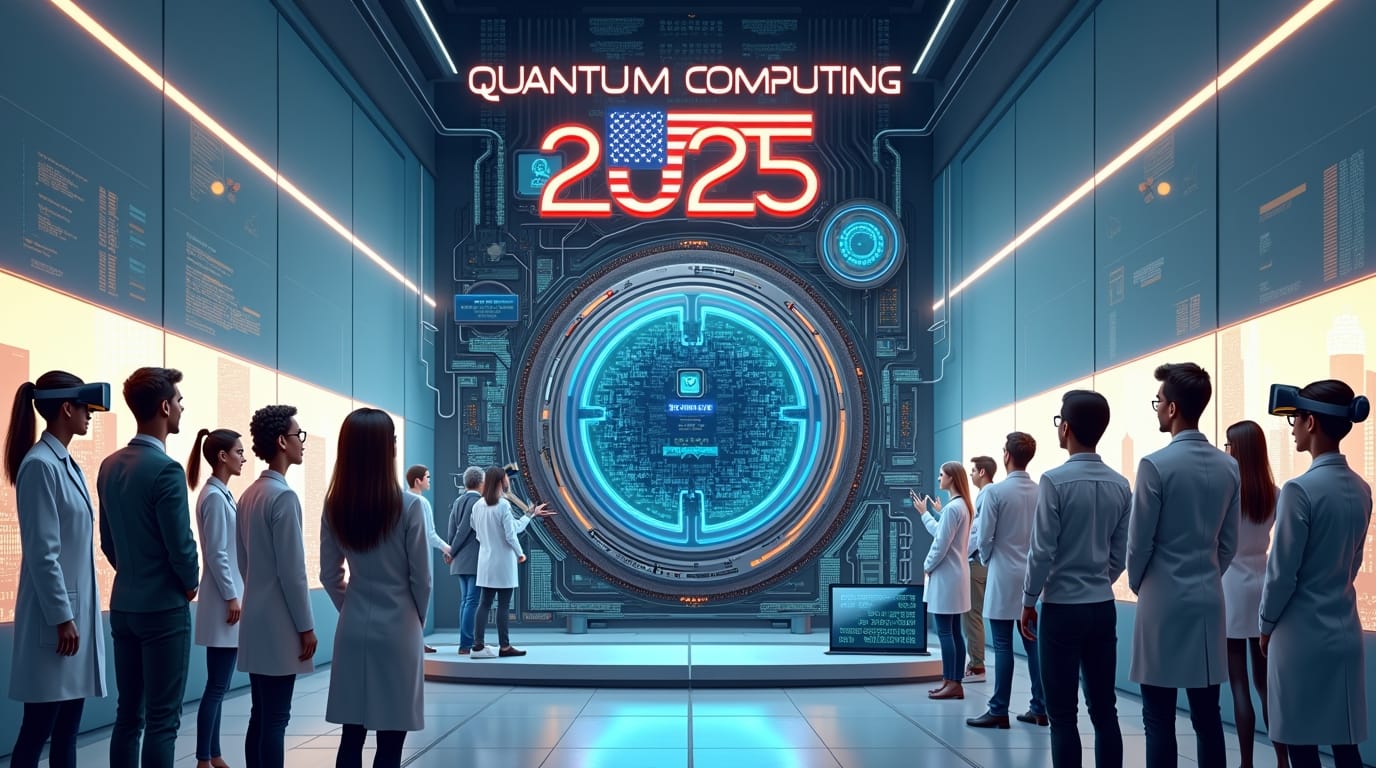
For more than a decade, quantum computing lived mostly in the world of theory, laboratory prototypes, and ambitious projections. But Quantum Computing Becomes Real in 2025 marks a dramatic turning point: quantum technologies are finally stepping beyond research labs and into real-world applications.
From drug discovery to cybersecurity, from advanced materials to national-level modeling, the United States is now embracing quantum computing as a strategically important technology — one that could reshape global power, scientific progress, and the digital economy.
2025 is no longer about “future potential.”
It’s about practical relevance — and the early signs of quantum advantage in real industries.
What Changed in Quantum Computing Becomes Real in 2025 The Shift From Theory to Application
Quantum computing has always promised extraordinary capabilities, but the challenge has been stability, scale, and error correction. In 2025, several breakthroughs have pushed quantum systems closer to commercial reality:
1. More Stable Qubits
New qubit architectures — including neutral-atom qubits and superconducting qubits with improved coherence times — have made quantum machines more reliable and predictable.
2. Progress in Quantum Error Correction
Fault-tolerant quantum computing is still years away, but improvements in error-mitigation algorithms have enabled today’s quantum devices to run more complex workloads with usable accuracy.
3. Cloud-Based Quantum Access
AWS Braket, IBM Quantum, Google Quantum AI, and other U.S. platforms now offer cloud access to quantum hardware, making it accessible to developers, universities, and enterprise teams.
4. Enterprise-Grade Quantum SDKs
New software development kits and hybrid quantum-classical frameworks mean developers no longer need a PhD in physics to experiment with quantum algorithms.
Together, these advancements mean quantum is no longer a science experiment — it’s a tool.
Why Quantum Computing Matters: The Power Behind the Hype
At a fundamental level, quantum computers process information differently.
Where classical computers use bits (0 or 1), quantum computers use qubits which can exist as both 0 and 1 at the same time.
This allows quantum systems to explore vast combinations of variables simultaneously — something classical systems cannot match.
Here’s why that matters:
1. Cryptography May Change Forever
Many modern encryption systems rely on mathematical problems that classical computers cannot solve efficiently.
Quantum computers, however, can break certain encryption algorithms dramatically faster.
This is why the U.S. government is accelerating its push toward post-quantum cryptography (PQC) — new encryption standards designed to withstand future quantum attacks.
The message is clear:
2025 is the preparation phase for a quantum-safe digital world.
How Quantum Will Impact Industries in 2025 and Beyond
Quantum computing will not replace classical computing — instead, it will augment and accelerate tasks that classical machines struggle with. Here are the industries being reshaped first.
1. Pharmaceuticals: Drug Discovery at Unprecedented Speed
Traditionally, drug discovery requires years of modeling how molecules behave.
Quantum computers can simulate molecular interactions with far greater accuracy, potentially reducing timelines dramatically.
Applications include:
- Identifying drug candidates for cancer, Alzheimer’s, autoimmune disorders
- Designing new protein structures
- Predicting molecular interactions before clinical trials
Big pharma companies in the U.S. are already running hybrid quantum-classical experiments to shorten research cycles.
2. Materials Science: Designing the Next Generation of Materials
Quantum computers can simulate atomic-level physics — unlocking new classes of materials such as:
- Hyper-efficient batteries
- High-temperature superconductors
- Lightweight aviation materials
- Semiconductors with atomic-level customization
Companies in aerospace, EV, and energy sectors are deepening quantum partnerships in 2025 to stay competitive.
3. Complex Systems Modeling: From Climate to Finance
Quantum computing excels at analyzing multidimensional systems.
This makes it ideal for:
- Climate prediction models
- Optimization of national power grids
- Global supply-chain simulations
- High-frequency market forecasting
- Large-scale logistics
The U.S. public sector is especially active here, with government science agencies now using quantum simulation experiments to improve predictive modeling.
4. Cybersecurity & Encryption Defense
While quantum computers could break traditional encryption, they also enable:
- Quantum-safe encryption algorithms
- Quantum-based random number generation
- Quantum key distribution (QKD), one of the most secure forms of communication
The U.S. cybersecurity community sees 2025 as a critical window to transition to PQC before large-scale quantum machines arrive later in the decade.

The Quantum Race: Why the U.S. Is Investing Aggressively in 2025
Quantum technology is now a geopolitically strategic asset.
The U.S., China, and the EU are all racing to achieve quantum advantage — where quantum computers outperform classical supercomputers for meaningful tasks.
The United States currently leads in:
- Cloud-accessible quantum hardware
- Quantum software and programming tools
- Private-sector innovation (IBM, Google, IonQ, Rigetti)
- University-level quantum research programs
Billions in federal funding are now flowing to:
- National Quantum Initiative
- U.S. Quantum Computing Roadmap
- Quantum Workforce Development
- Quantum-AI integration programs
2025 is shaping up to be the year the U.S. sets the pace for the global quantum economy.
Challenges That Still Remain
Despite the momentum, quantum computing still faces obstacles:
- Error correction: Fully fault-tolerant quantum systems are still years away.
- Scalability: Current quantum machines have limited qubit counts.
- Talent shortage: The U.S. lacks enough quantum engineers and physicists to meet industry demand.
- Cost & infrastructure: Quantum hardware requires extreme conditions (microwave controls, cryogenic cooling).
But even with these challenges, the industry is progressing faster than expected — and 2025 marks the beginning of practical utility.
Why 2025 Is a Turning Point
This year represents a historic shift:
- Quantum is moving from “research curiosity” → “industry pilot projects.”
- Companies are building hybrid systems combining classical AI + quantum algorithms.
- Government agencies are adopting AI-driven quantum modeling in health, defense, and cybersecurity.
- Investors are pouring money into quantum startups at record levels.
The next phase — between 2025 and 2030 — is where quantum computers may start outperforming classical machines in critical industries.
Conclusion: The Quantum Era Has Begun — And the U.S. Is Leading It
Quantum computing is no longer a distant concept.
In 2025, it is becoming an actionable technology shaping the future of pharmaceuticals, materials, cryptography, climate science, finance, and more.
The U.S. has an early lead in hardware innovation, software development, national-level policy, and enterprise adoption — positioning American businesses and institutions at the center of the global quantum revolution.
As quantum and AI continue to merge, the 2025-2030 decade could become one of the greatest technological turning points in modern history.
Read More on USATrends.tech